Introduction
Modern software teams can’t afford slow releases, broken builds, or insecure deployments. That’s why combining Docker + CI/CD has become the backbone of modern DevOps in 2026.
With containers ensuring consistency and CI/CD pipelines automating everything from testing to deployment, teams can ship features faster without sacrificing reliability or security.
In this guide, we’ll cover the best practices for Docker CI/CD pipelines in 2026, including security, performance, scalability, and cost optimization.
Why Docker + CI/CD Is Essential in 2026
Containerization has moved from “nice-to-have” to mission-critical. Platforms like Docker, Inc. standardized application packaging, while orchestration tools like Kubernetes made container deployment scalable.
Today’s DevOps teams rely on:
- Reproducible builds
- Automated testing pipelines
- Immutable infrastructure
- Secure container supply chains
- Multi-cloud deployments
Without Docker in your CI/CD pipeline, you risk:
- Environment inconsistencies
- Deployment drift
- Slow build cycles
- Security vulnerabilities in production
Docker + CI/CD Best Practices for 2026
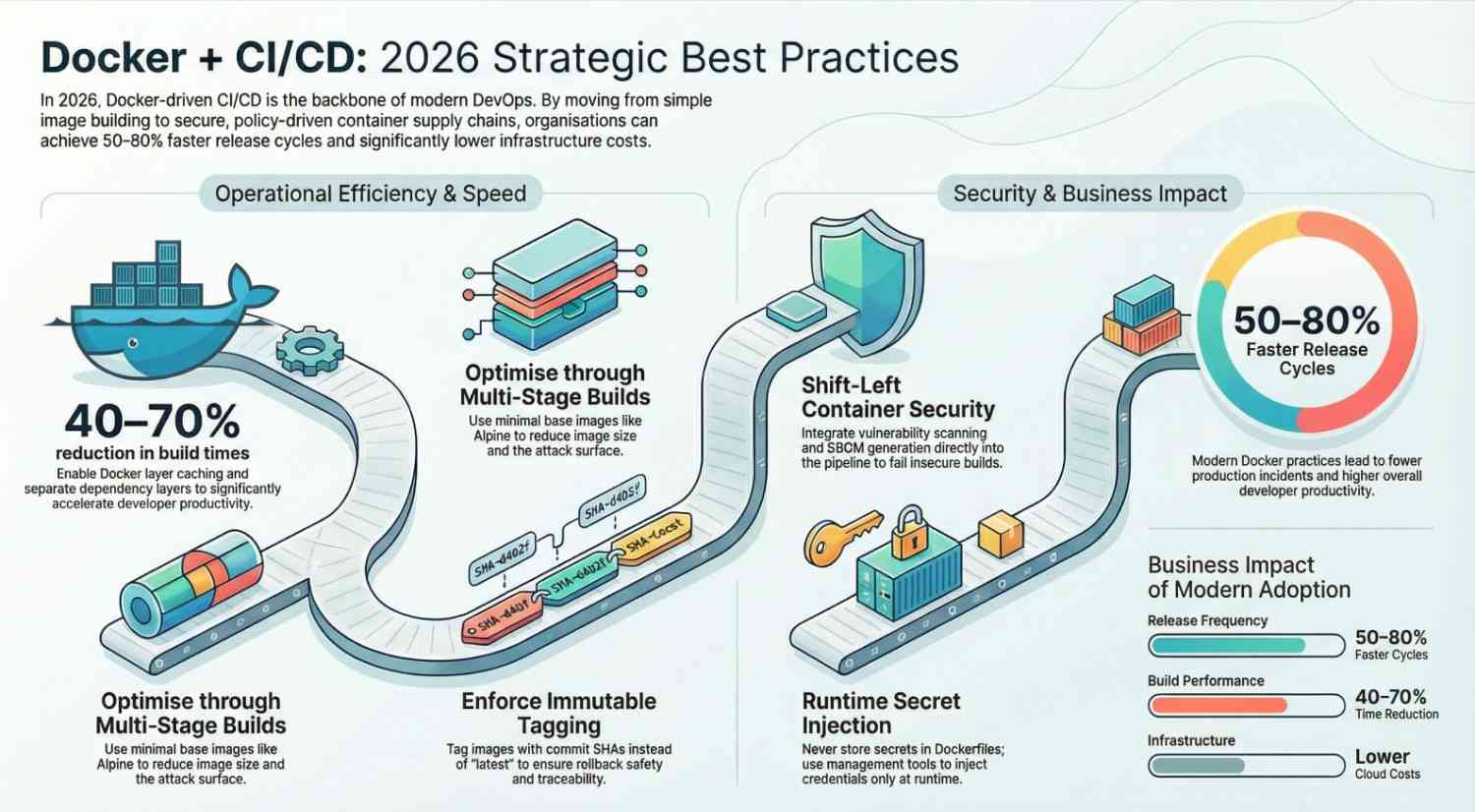
1. Use Multi-Stage Builds to Optimize Image Size
Large container images slow down your CI/CD pipeline.
Best practice:
- Use multi-stage Docker builds
- Remove build dependencies
- Use minimal base images (e.g., Alpine, Distroless)
Smaller images mean:
- Faster builds
- Faster deployments
- Reduced attack surface
- Lower cloud costs
2. Shift Left on Container Security
Security must start inside your CI/CD pipeline.
In 2026, secure Docker pipelines include:
- Image vulnerability scanning
- SBOM generation
- Signed container images
- Secret detection
- Dependency scanning
Use built-in scanning tools and integrate them directly into your CI workflow.
Pro tip: Fail the build automatically if critical vulnerabilities are detected.
3. Implement Layer Caching for Faster Builds
CI build times directly impact developer productivity.
To optimize:
- Enable Docker layer caching
- Cache dependency layers separately
- Avoid invalidating base layers unnecessarily
This can reduce build time by 40–70% in large projects.
4. Use Immutable Image Tagging (Never “latest”)
Never deploy using latest.
Instead:
- Tag images with commit SHA
- Use semantic versioning
- Promote images across environments (dev → staging → prod)
Immutable tags ensure:
- Traceability
- Rollback safety
- Compliance readiness
5. Integrate Docker with Modern CI/CD Platforms
Leading CI/CD platforms in 2026 include:
Best practice:
- Use Docker-in-Docker carefully
- Prefer remote builders when possible
- Run pipelines in isolated environments
6. Secure Secrets Properly
Never store secrets in:
- Dockerfiles
- Git repositories
- Environment variables in plain text
Instead:
- Use secret management tools
- Inject secrets at runtime
- Use ephemeral credentials
A secure Docker CI/CD pipeline isolates secrets from build artifacts.
7. Automate Testing Inside Containers
Your CI/CD pipeline should:
- Run unit tests inside containers
- Run integration tests with Docker Compose
- Spin up dependent services (DB, cache, queue)
This guarantees test environments match production.
8. Implement Policy-as-Code
Enterprise DevOps teams now enforce:
- Image approval policies
- Base image restrictions
- Mandatory scanning gates
- Registry controls
Policy-as-code ensures compliance without manual review bottlenecks.
9. Optimize for Multi-Cloud Deployments
Modern CI/CD pipelines deploy containers across:
- AWS
- Azure
- Google Cloud
- On-prem clusters
Best practice:
- Build once
- Push to a secure registry
- Deploy via environment-specific configs
Avoid rebuilding images per environment.
10. Monitor, Observe, and Roll Back Automatically
A mature Docker CI/CD strategy includes:
- Deployment health checks
- Automatic rollback triggers
- Observability integration
- Canary deployments
- Blue-green deployments
With orchestration platforms like Kubernetes, automated rollbacks are easier than ever.
Security Trends in Docker CI/CD (2026)
In 2026, secure container pipelines focus on:
- Software supply chain protection
- Signed artifacts
- Zero-trust runtime environments
- Runtime threat detection
- SBOM compliance requirements
Security is no longer optional it’s regulatory.
AI + Docker in CI/CD Pipelines
A growing trend is integrating AI tools into pipelines:
- AI code review
- Automatic Dockerfile optimization
- Vulnerability prioritization
- Performance anomaly detection
Dockerized AI services make experimentation safe and reproducible.
Business Benefits of Docker CI/CD
Organizations adopting modern Docker CI/CD best practices report:
- 50–80% faster release cycles
- Fewer production incidents
- Lower cloud infrastructure costs
- Higher developer productivity
- Stronger security posture
In short: automation + containerization = competitive advantage.
Final Thoughts
Docker + CI/CD in 2026 is no longer about just “building images.” It’s about:
- Secure container supply chains
- Fast automated pipelines
- Policy enforcement
- Cloud-native scalability
- DevOps maturity
Whether you’re a startup or an enterprise, implementing these Docker CI/CD best practices will help you build faster, deploy safer, and scale confidently.
- If you want to explore DevOps, start your training here.